
Developing a Water Exercise Program for Individuals With Stroke
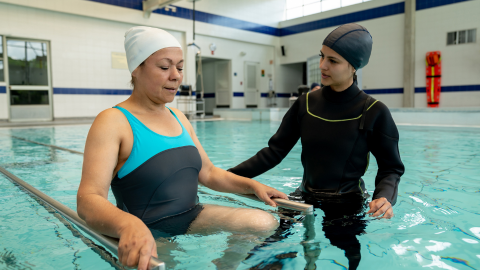
Developing a Water Exercise Program for Individuals With Stroke
This course includes
The instructors
Overview
This course explores how to design and implement an evidence-based water exercise program for individuals living with stroke.
Led by Olivia Manning, a registered physiotherapist and PhD candidate specializing in neurorehabilitation, this course addresses a critical gap in stroke care: the lack of accessible, long-term rehabilitation options beyond the early recovery phase.
Participants will examine the evolving understanding of stroke recovery timelines, the high prevalence of persistent impairments and falls, and the role of community-based interventions in supporting ongoing functional gains. The course highlights how aquatic environments can be leveraged to safely improve balance, strength, cardiovascular fitness, and mobility, while enhancing patient confidence and participation.
Grounded in both research and real-world application, this course bridges the gap between evidence and practice, equipping clinicians with the tools to develop effective, patient-centered aquatic rehabilitation programs.
Learning Objectives
By the end of this course, participants will be able to:
-
Describe the long-term rehabilitation needs of individuals post-stroke
-
Explain current evidence related to stroke recovery timelines and neuroplasticity
-
Identify key impairments affecting function and fall risk after stroke
-
Understand the benefits and clinical applications of aquatic therapy in stroke rehabilitation
-
Apply principles of evidence-based practice to program development
-
Design safe, progressive, and functional water-based exercise programs
-
Integrate balance, strength, and cardiovascular training into aquatic environments
-
Address barriers to long-term rehabilitation and community program access
-
Incorporate patient-centered and culturally respectful approaches into care
-
Translate research into practical, clinically relevant interventions
Audience
This course is designed for healthcare professionals involved in neurological rehabilitation and exercise prescription, including:
-
Physiotherapists
-
Occupational therapists
-
Kinesiologists
-
Rehabilitation assistants
-
Exercise professionals working with neurological populations
Why This Course Matters
Stroke remains a leading cause of long-term disability, yet rehabilitation services often decline sharply after the first few months post-event. Many individuals are left without the support needed to continue improving function, fitness, and independence.
This course addresses that gap by:
-
Challenging outdated assumptions about limited recovery timelines
-
Highlighting the importance of long-term, progressive rehabilitation
-
Providing a scalable, community-based solution through aquatic therapy
-
Supporting clinicians in delivering safe, engaging, and effective programs
By integrating evidence, clinical expertise, and patient-centered design, this course empowers clinicians to extend care beyond traditional settings and timelines - ultimately improving outcomes and quality of life for stroke survivors.
About the Presenter
Olivia J Manning, Masters of Science in Physical Therapy (MScPT)

Olivia Manning is a Neurological Physiotherapist at Providence Care Hospital and PhD Candidate in Rehabilitation Sciences at Queen's University in Kingston, Ontario. Her current research studies the gap between formal rehabilitation and community wellness for stroke survivors. Previously she has completed research in the areas of Multiple Sclerosis, gait analysis, aging in place for older adults (The Oasis Project) and corticospinal excitability. Olivia strongly believes in embracing the complexity of neurological populations in research trials and creating opportunities for more severely impaired individuals to be active in the community.
The instructors

Material included in this course
-
Course Materials
-
Welcome
-
Introduction
-
Water Based Activity
-
Research Questions
-
Stakeholder Consultation and Participant Experiences
-
Next Steps
-
Questions
-
Feedback
Is a certificate of completion included with this course?
Once you have completed the course, a certificate of completion (including learning hours and course information) will be generated. You can download this certificate at any time. To learn more about course certificates on Embodia please visit this guide.
This can be used for continuing education credits, depending on your professional college or association. If this course has been approved for CEUs in specific jurisdictions, it will be noted on the course page and CEU information may be added to your course certificate. Please read this guide for more information.
I'm a member of the Canadian Physiotherapy Association (CPA). What are the discounts available to CPA Members on Embodia?
As part of our partnership with the CPA, we offer its members discounts on courses and Embodia Memberships. Learn more about the partnership on this page.
In order for the discount to be applied, you first need to authenticate your CPA membership. This is an important step as this is how Embodia 'knows' that you are a CPA member.
To authenticate as a CPA member, you need to sign in the CPA portal on this page, sign in to your CPA account, and then click the button on the page.
Please note that your email address on your CPA account must match your email address on Embodia. If needed, you can update your information on Embodia as outlined in this guide.
